

When visitors first set eyes on Halong Bay, they are often left speechless by the sight of thousands of limestone islands rising dramatically from emerald-green waters. The landscape seems almost otherworldly—a maze of towering karsts, hidden caves, secluded lagoons, and rugged cliffs stretching across the horizon.
Yet beyond its breathtaking beauty lies a story far more remarkable than many travelers realize. Halong Bay is not merely a scenic destination; it is one of the world's most extraordinary geological treasures. Every island, cave, and limestone pinnacle tells a story that began hundreds of millions of years ago, making the bay a living record of Earth's geological evolution.
Recognized twice by UNESCO as a World Heritage Site, Halong Bay is celebrated not only for its natural beauty but also for its exceptional geological and geomorphological significance. To truly appreciate this iconic destination, it helps to understand the incredible natural forces that shaped it into the masterpiece we see today.
A Journey Back More Than 500 Million Years
The geological history of Halong Bay stretches back over 500 million years, long before humans existed.
During ancient geological periods, the region that is now northeastern Vietnam lay beneath a warm, shallow tropical sea. Over countless millennia, the remains of marine organisms—including corals, shells, and other calcium-rich creatures—accumulated on the seabed. These deposits gradually formed thick layers of limestone, the very foundation of Halong Bay's famous islands.
As tectonic forces beneath the Earth's surface slowly shifted, these limestone deposits were uplifted above sea level. Mountains emerged where oceans once existed, marking the beginning of a geological transformation that would continue for millions of years.
Nature was only getting started.
Understanding Karst Landscapes: The Secret Behind Halong Bay's Shape
One of the most important geological concepts behind Halong Bay is something known as "karst topography."
Karst landscapes form when limestone is gradually dissolved by slightly acidic rainwater. Although this process may seem insignificant on a day-to-day basis, over millions of years it becomes an incredibly powerful force of transformation.
Rainwater absorbs carbon dioxide from the atmosphere and soil, creating a weak carbonic acid. As this water seeps into cracks and fissures within the limestone, it slowly dissolves the rock, enlarging these openings year after year.
Over vast periods of time, this process creates:
- Towering limestone pillars
- Deep sinkholes
- Underground rivers
- Hidden caverns
- Natural tunnels
- Dramatic cliff faces
Halong Bay represents one of the finest examples of mature tropical karst landscapes anywhere on Earth. The sheer scale and complexity of its formations make it a geological wonder admired by scientists and travelers alike.
Why Are There Thousands of Islands?
One of the first questions many visitors ask is: why does Halong Bay have so many islands?
The answer lies in millions of years of uneven erosion.
Not all limestone is equally resistant to weathering. Some sections dissolve more quickly, while others remain intact. As water and wind gradually wore away weaker rock formations, the stronger limestone masses survived, eventually becoming isolated towers and islands.
Today, more than 1,600 limestone islands and islets are scattered across the bay, each shaped by unique geological conditions.
Some resemble animals, others look like ancient castles, and many have inspired local legends and folklore.
Among the most famous formations are:
The Hidden World Beneath the Limestone Mountains
- Fighting Cocks Islet (Hon Ga Choi)
- Stone Dog Islet (Hon Cho Da)
- Incense Burner Islet (Hon Dinh Huong)

These iconic landmarks have become enduring symbols of Halong Bay and are instantly recognizable to visitors from around the world.
While the islands themselves are spectacular, some of Halong Bay's greatest geological wonders lie hidden within them.
For millions of years, rainwater continued to penetrate the limestone, carving vast networks of underground chambers. The result is an extraordinary collection of caves and grottoes that reveal the ongoing story of geological evolution.
Sung Sot Cave – Nature's Underground Palace
Known as Surprise Cave, Sung Sot Cave is among the largest and most impressive caves in Halong Bay.
Visitors entering the cave are greeted by enormous chambers filled with dramatic stalactites and stalagmites that have formed drop by drop over thousands of years. Some formations resemble animals, mythical creatures, or natural sculptures shaped entirely by mineral deposits.
The scale of the cave is so immense that many first-time visitors find it difficult to believe it was created solely by natural processes.
Thien Cung Cave – The Heavenly Palace
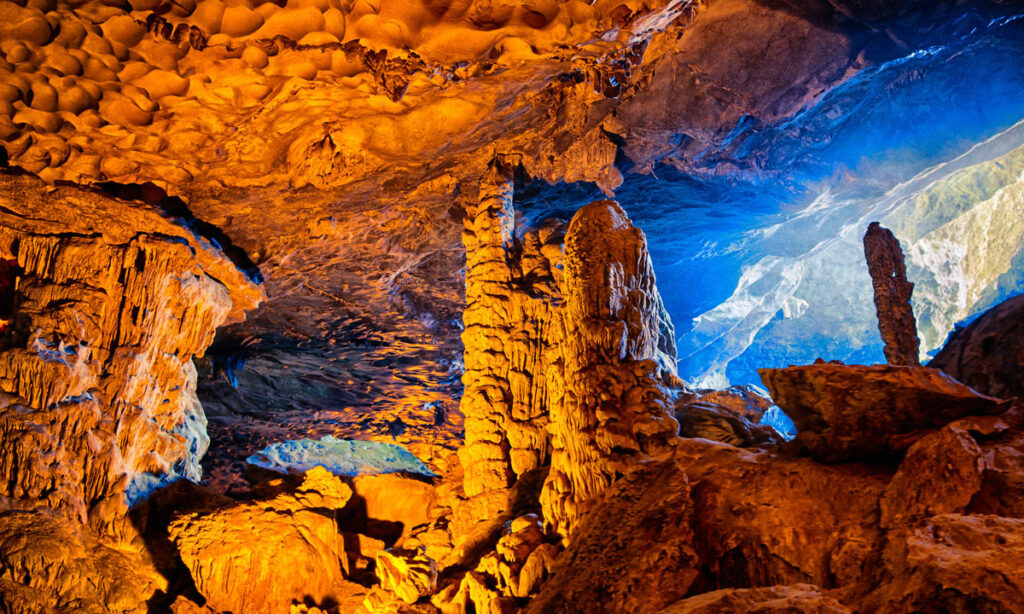
Another geological masterpiece, Thien Cung Cave features intricate limestone formations illuminated by colorful lighting.
Its walls and ceilings are decorated with countless mineral formations that have developed over millennia, creating a landscape that resembles a natural cathedral beneath the earth.
Luon Cave – A Gateway to Hidden Lagoons
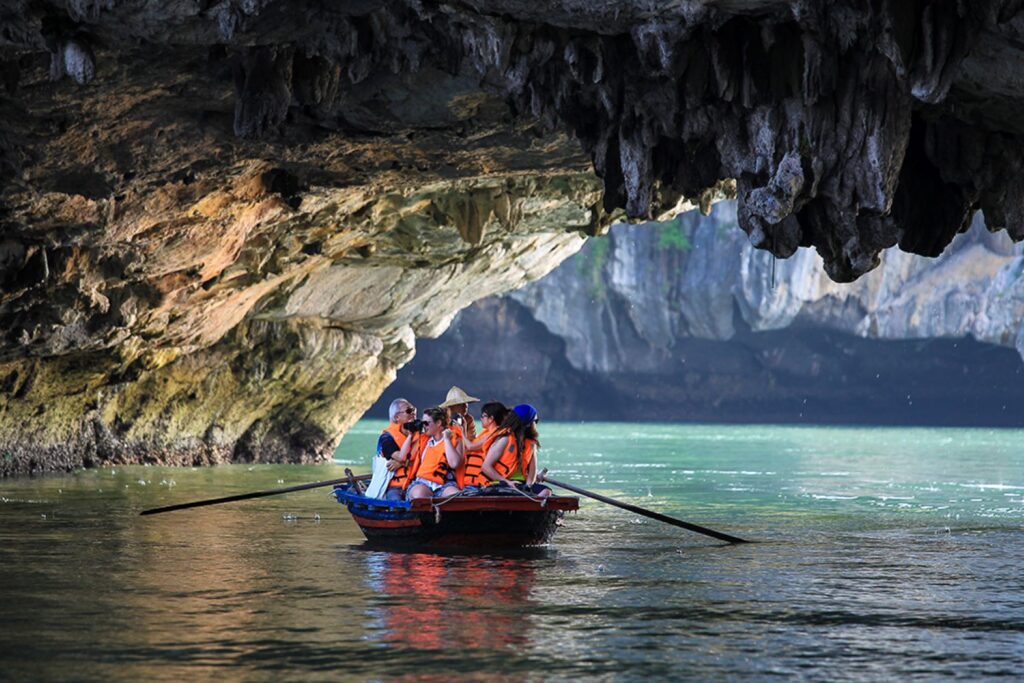
Unlike traditional caves, Luon Cave offers a unique experience where visitors paddle through a low tunnel by kayak or bamboo boat to reach a secluded lagoon enclosed by towering limestone cliffs.
This remarkable feature demonstrates how erosion continues to shape the landscape even today.
The Role of Climate and Sea-Level Changes
The story of Halong Bay cannot be told without understanding the influence of climate change throughout Earth's history.
Over millions of years, global temperatures fluctuated dramatically. During ice ages, vast quantities of water became trapped in glaciers, causing sea levels to fall. During warmer periods, glaciers melted and sea levels rose again.
These repeated cycles transformed the landscape multiple times.
When sea levels were lower, rivers carved valleys through the limestone terrain. Later, rising seas flooded these valleys, creating the spectacular marine landscape that exists today.
This process is known as "marine transgression" and is responsible for the unique appearance of Halong Bay, where limestone mountains seem to emerge directly from the water.
In geological terms, Halong Bay is considered a "drowned karst landscape"—one of the best-preserved examples in the world.

More Than Beauty: A Geological Laboratory
For geologists, Halong Bay is far more than a tourist destination.
The bay serves as a natural laboratory where scientists can study:
- Karst formation processes
- Climate history
- Sea-level fluctuations
- Limestone weathering
- Coastal ecosystem evolution
Researchers from around the world continue to visit Halong Bay to better understand how landscapes evolve over geological timescales.
The bay provides valuable insights into Earth's past while helping scientists predict future environmental changes.

A Landscape That Supports Life
The geological features of Halong Bay do more than create stunning scenery—they also support a rich and diverse ecosystem.
The limestone islands create sheltered habitats for numerous species of plants and animals. Hidden lagoons, mangrove forests, coral reefs, and coastal wetlands provide ideal conditions for marine life to thrive.
Many rare species have adapted specifically to this unique environment, making the bay important not only from a geological perspective but also from an ecological one.
This close relationship between geology and biodiversity is one of the reasons UNESCO considers Halong Bay a site of outstanding universal value.
The Best Ways to Experience Halong Bay's Geological Wonders
To fully appreciate the geological story of Halong Bay, visitors should explore the landscape from multiple perspectives.
A cruise through the bay offers panoramic views of the towering limestone karsts and allows travelers to understand the immense scale of the formations.
Kayaking provides access to hidden lagoons, cave entrances, and secluded corners that larger vessels cannot reach.
Guided cave excursions reveal the intricate details of stalactites, stalagmites, and underground chambers formed over thousands of years.
For photographers, sunrise and sunset are particularly magical moments, as changing light conditions highlight the textures, contours, and dramatic silhouettes of the limestone islands.
Halong Bay is often described as one of the most beautiful places on Earth, but its true wonder goes far beyond what meets the eye.
Beneath its tranquil waters and towering limestone islands lies a geological story that spans more than half a billion years. Ancient seas, tectonic movements, climate shifts, erosion, and rising oceans have all played a role in shaping this extraordinary landscape.
Every cave, cliff, and island is a chapter in a story written by nature over unimaginable timescales.
For travelers, understanding the geological origins of Halong Bay transforms a beautiful sightseeing experience into something much deeper—a journey through Earth's history itself.
The next time you sail through the emerald waters of Halong Bay, take a moment to look beyond the scenery. What you are witnessing is not only a UNESCO World Heritage Site but one of the planet's greatest geological masterpieces, patiently crafted by nature over millions of years.